
Are Stainless Steel Pipe Screens Safe? The Ultimate Guide to Health and Quality
- By Nicoo Tong
- Last Updated: August 18, 2026
If you are a smoker, a Vape enthusiast or a DIY user using wire mesh, the question of safety has undoubtedly crossed your mind: Are stainless steel pipe screens safe to use?
With so much conflicting information online, it’s easy to get confused. Some claim they release harmful toxins, while others swear by them. As a professional manufacturer of high-quality stainless steel wire mesh, we are here to clear the smoke and provide a definitive, science-Based answer.
The short answer is YES, but with one massive caveat: only if they are made from the correct grade of high-quality, food-grade or medical-grade stainless steel.In this post, we will dive into the material science, explore potential risks, and show you how to identify truly safe pipe screens.
Understanding the Material: Why Stainless Steel?
Not all metals are created equal. When a metal screen is subjected to high heat, its chemical stability is put to the test.
What Makes Stainless Steel Unique?
Stainless steel is an alloy, primarily made of Iron, Chromium (at least 10.5%), and Nickel. The crucial element here is Chromium. When exposed to oxygen, it forms an microscopic, self-healing layer of Chromium Oxide on the surface. This is the “passive layer” that makes it stainless (corrosion-resistant).
Food-Grade vs. Industrial-Grade
This is where safety begins.
Industrial-Grade: May contain higher levels of impurities, carbon, or unsafe oils from the manufacturing process. These are NOT safe for heating and inhalation.
Food-Grade (e.g., T304) & Medical-Grade (e.g., T316): These alloys are strictly controlled for purity. They are designed to withstand high heat and corrosive environments without leaching harmful chemicals.

Potential Health Risks: Myths vs. Reality
Let’s address the scary claims you might have read about heating stainless steel.
Myth 1: They Release Harmful Heavy Metal Fumes
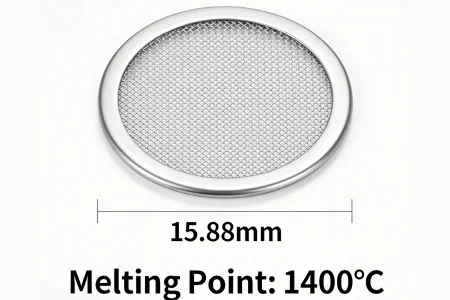
Reality: The melting point of T304 stainless steel is approximately 1,400°C (2,550°F). The flame from a standard lighter reaches about 1,900°C, but the actual temperature of the screen in a pipe bowl during a hit rarely exceeds 600°C–800°C for more than a second or two. At these temperatures, high-grade stainless steel does not melt or release significant heavy metal fumes (like Hexavalent Chromium).
Myth 2: They Break Down and You Inhale Metal Particles
Reality: Low-quality screens can become brittle after repeated heating and cooling cycles, causing small fragments to break off. So high-quality, correctly annealed stainless steel mesh retains its structural integrity and will prevent dangerous particulate inhalation.
Comparison: Stainless Steel vs. Brass vs. Glass
To understand why stainless steel is often the preferred choice, we must compare it to the alternatives. The alternatives are Brass and Glass material. We have made a table for better comparison as below;
| Feature | Food-Grade Stainless Steel (T304/316) | Brass (Copper/Zinc Alloy) | Glass (Borosilicate) |
|---|---|---|---|
| Heat Resistance | Excellent (>1000°C) | Moderate (<900°C) | Moderate-High |
| Durability | Extremely Durable | Fragile (Breaks easily) | Fragile |
| Taste Impact | Neutral (No taste) | have metallic taste | Purest taste |
| Cleaning | Easy (Torch or soak) | Moderate-Difficult | Easy (Soak) |
| Cost Efficiency | High (Lasts a long time) | Low (Needs frequent replacement) | Moderate (One-time purchase, unless broken) |
| Safety Risk | Very Low (if high-grade) | Potential for zinc fumes / oxidized coating | Extremely Low |
Why High-Grade Stainless Steel is Often Better Than Brass:
Brass is an alloy of Copper and Zinc. Zinc has a much lower melting point than stainless steel. When brass screens are overheated (which happens often), they can oxidize and release Zinc Oxide fumes, which can cause a temporary flu-like condition known as “Metal Fume Fever.” Stainless steel does not pose this specific risk.
How to Identify Safe and High-Quality Stainless Steel Screens
Now let us tell you how to identify sage and high quality stainless steel screen.
1. Know the Grade: T304 or T316
Always look for suppliers that specify the alloy grade. T304 is the industry standard for food and beverage equipment. T316 offers even higher corrosion resistance, often used in medical implants. Avoid “unknown” steel alloys.
2. Cleanliness matters
High-quality screens should be oil-free. Some industrial mesh manufacturing processes use cutting oils or lubricants. A reputable manufacturer will perform a post-production cleaning (like ultrasonic cleaning) to ensure the mesh is residue-free and ready for use.
Conclusion: Priority on Quality
Are stainless steel pipe screens safe?
Yes, when they are made from certified Food-Grade Stainless Steel (T304) or Medical-Grade (T316) stainless steel. Their high melting point, structural stability and neutral taste make them one of the best and most durable filtration solutions available.
Do not compromise on health for the sake of a cheaper product. Always choose a reputable manufacturer that guarantees the purity and cleanliness of their stainless steel mesh. We are the stainless steel pipe mesh factory since 2007 and can provide the reliable goods to you. If you are looking for best stainless steel pipe screens supplier, just contact us. We are the expert and can answer whatever questions.

Nicoo Tong
Why Choose Our Stainless Steel Mesh Screen?
Factory Direct Price
We are the factory and can give you best support on price.
Best Quality Control
Complete quality control system on extruder filter screen and 100% OQC to keep the quality.
Fast Delivery
Lead time is about 15-30 days after receipt of the deposit. Repeat order will be shorter.
One Stop Service
From inspection of raw material, extruder filter punching, welding, processing, packaging and container loading
Rich Extruder Filter Experiences
We got rich working experience with global customers over lots of extruder filter projects.
High Precision Extruder Filter Processing
Equipped with advanced processing machine from Japan and Germany to keep the high precision of all kinds of extruder filter screen.
What about the Cost of Stainless Steel Pipe Screens?

Ask for SS Pipe Screens Price Now!
FAQ on Stainless Steel Pipe Screens?
What size pipe screen fits most pipes?
5/8 inch pipe screens are one of the most commonly used sizes.
How long do stainless steel pipe screens last?
With proper cleaning, stainless steel pipe screens can last several weeks or months.
Are stainless steel pipe screens reusable?
Yes. Simply rinse them with warm water and reuse.
How many stainless steel pipe screens sizes are used in the market?
- 3 8 inch stainless steel pipe screens
- 5 8 stainless steel pipe screens
- 3/4 stainless steel pipe screens
- 1 2 inch stainless steel pipe screens
- 1 inch stainless steel pipe screens
What material is used for stainless steel pipe screens?
Common material is ss304 or 316.
Is a Stainless steel pipe screens better than paper filters?
Yes. The material of stainless steel pipe screens is 304 or 316, it is reusable and heat-resistant.
Which is better brass or stainless steel pipe screens?
We write a detailed blog to discuss this issue. Pls click here for more info.