
How to Measure Mesh Screen Size: The Ultimate Professional Guide
- By Nicoo Tong
- Last Updated: August 18, 2026
As a leading company in stainless steel wire mesh, we know that accuracy is everything. Whether you are in the chemical, food processing or pharmaceutical industry, only the exact mesh size can ensure accurate filtration performance, otherwise using the wrong mesh size will lead to filtration failure.
But how do you verify if the stianless steel wire mesh roll you received is actually 50 mesh or 100 mesh? In this guide, we break down the four professional methods to measure mesh screen size accurately and also provide conversion charts which will help you choose the correct mesh size for your application.
Firstly, let us have a description on mesh screen size.
What is Mesh Screen Size?
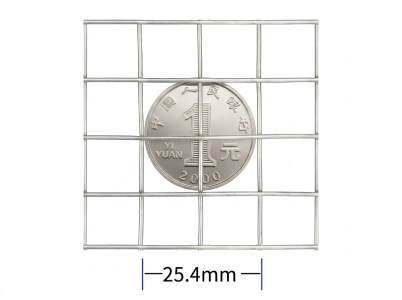
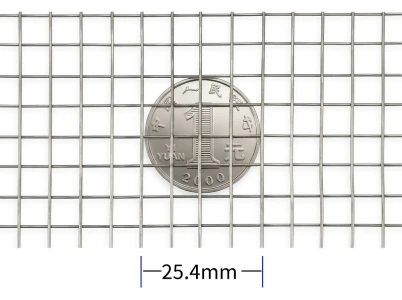
Mesh screen size refers to the number of openings (holes) per linear inch (25.4mm) in a screen or mesh material. We have made 2 pictures of 2 mesh and 4 mesh screen for better understanding.
- A 2 mesh screen means there are 2 openings per inch
- Lower mesh number (e.g., 2–80 mesh)= larger openings, thick wires, used for coarse filtration.
- Higher mesh number (e.g., 200–500 mesh)= smaller openings, thin wires, used for precision separation.
This measurement is critical for filtration precision, especially in industries like chemical processing, food production and pharmaceuticals.
How to Measure Mesh Screen Size?
In a word, there are 4 ways to measure mesh screen size depending on available tools and required accuracy. Let us describe the method one by one. The Mesh Count refers to the number of openings per linear inch (25.4 mm). Accurate measurement is critical for ensuring the screen meets international industrial standards.
Method 1 – The Standard Steel Ruler (Best for 1 - 20 Mesh)
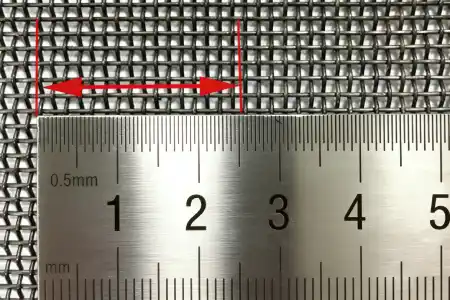
For coarse mesh, a simple steel ruler is the most cost-effective tool.
Place the standard steel ruler on the mesh surface.
Align the “0” mark with the center of any wire.
Count the number of openings within 1 inch (25.4mm).
The number = mesh size
Example:
- 5 openings = 5 mesh
- 20 openings = 20 mesh
- The mesh is 16 mesh for the left pictures measured by standard steel ruler.
- Pros: Low cost, easy to use. Cons: High risk of human error for fine mesh.
Method 2 – The Modern Mesh Counter Ruler (Best for 20 - 500 Mesh)
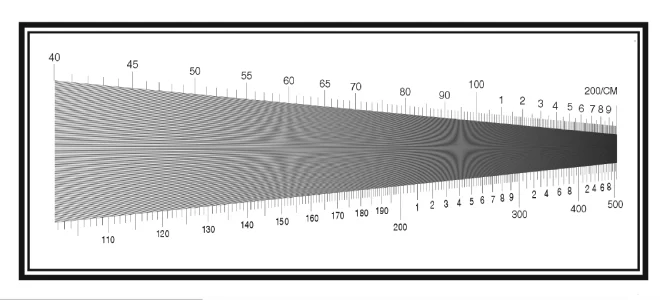
The mesh counter ruler (made of glass or film) is the fastest tool for modern quality control. It is the enhanced version of ruler. It uses the Moiré Effect to identify mesh size instantly. Here is the steps. I will insert the “water-wave” pattern pictures for your review.
Place the transparent ruler over the stainless steel mesh.
Move it slightly until a “water-wave” or “star” pattern appears.
The point where the pattern converges on the scale indicates the exact mesh count.
- The mesh is 240 mesh for the left pictures measured by The mesh counter ruler.
- Pros: Extremely fast, non-destructive, and eliminates manual counting fatigue.
Method 3 – The Optical Magnifier (Best for 80 - 250 Mesh)
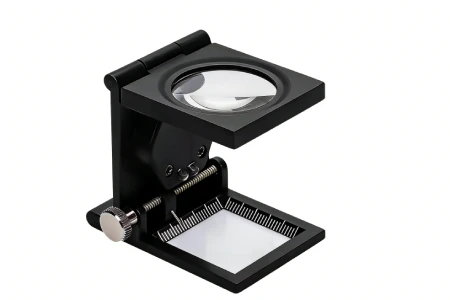
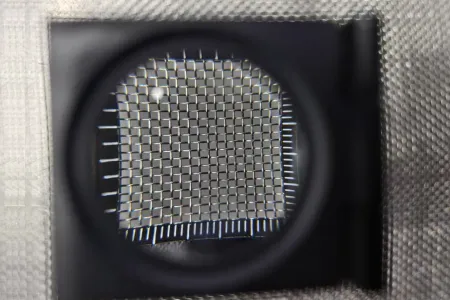
When the mesh is too fine for a ruler but doesn’t require a lab, a 10x or 20x optical magnifier is the industry standard. The optical magnifier is common used in stainless steel and fiber wire mesh cloth.It is ideal for standard industrial filters.
Step-by-Step Guide to Measuring Mesh Size:
1. Prepare the stainless steel mesh
Lay the stainless steel wire mesh flat on a smooth surface.
Pro Tip: Place a sheet of white paper underneath the mesh. This will reduce glare from the stainless steel and makes the wire outlines much sharper for counting.
2. Align the Measuring Tool
Position your mesh counting glass (magnifier) or ruler directly onto the mesh.
Ensure the scale line is perfectly parallel to one of the warp wires (vertical wires).
3. Count the Openings
Count the number of complete openings within a 10mm (1cm) distance, starting from the edge of the first wire.
You only need to count in one direction (either warp or weft) if the mesh is a standard square weave.
4. Apply the Calculation
To convert your 10mm count into the standard Mesh Count (per inch), use this simple formula:
Formula: Count in 10mm × 2.54 = Mesh Count
Take the picture left for example:
- You count 16 openings within 10mm.
- Calculation: 16* 2.54 = 40
- Result: Approximately 40 Mesh.
Method 4 – Measuring Microscope (Best for 250 - 630+ Mesh)
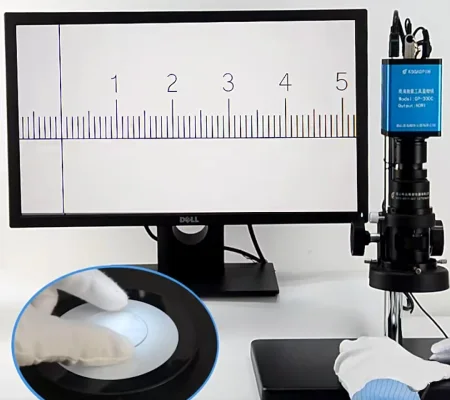
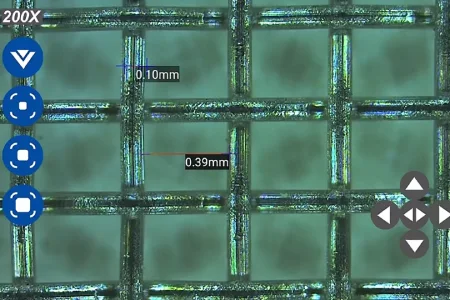
For ultra-fine “micron-grade” mesh, a digital microscope is required to observe the weave structure and measure dimensions at 50x to 200x magnification.
Range: Used for high-precision laboratory and pharmaceutical-grade mesh.
Analysis: It measures the Wire Diameter and Aperture to calculate the mesh count via the formula:
Mesh =25.4/(wire diameter+opening size)
For a better understanding, we would like to take the picture left for example.
- wire diameter=0.1mm
- opening size=0.39mm
- Calculation: 25.4/(0.1+0.39)=52
- Result: Approximately 52 Mesh.
Comparison of Measurement Tools
We have listed the 4 methods, and made a comparison table for your better understanding.
| Tool | Recommended Range | Best For |
|---|---|---|
| Steel Ruler | 1 - 20 Mesh | Coarse screens & mining mesh |
| Mesh Counter Ruler | 20 - 500 Mesh | Rapid warehouse QC & inspections |
| Optical Magnifier | 80 - 250 Mesh | Checking weave quality & count |
| Microscope | 250 - 630 Mesh | Lab analysis & micron-grade mesh |
Mesh to Micron Conversion Chart (Detailed)
Mesh and micron are NOT the same:
- Mesh = number of holes
- Micron = size of each hole
Althought they are not the same, but they can be conversed, The chart below shows the approximate size in inches and microns for various mesh sizes. These values are generally accepted as accurate but are approximates because the thickness of the wire used to makea specific screen will vary the number of openings in the one square inch. A micron is one-millionth of a meter or one-twenty-five thousandths of an inch. Most grades below 325 mesh are indicated by the micron size as these sizes are not manufactured using screens.
| US Mesh | Micron (µm) | Inches | Millimeters (mm) |
|---|---|---|---|
| 4 | 4750 | 0.187 | 4.75 |
| 5 | 4000 | 0.157 | 4 |
| 6 | 3350 | 0.132 | 3.35 |
| 7 | 2800 | 0.111 | 2.8 |
| 8 | 2360 | 0.0937 | 2.36 |
| 10 | 2000 | 0.0787 | 2 |
| 12 | 1700 | 0.0661 | 1.7 |
| 14 | 1400 | 0.0555 | 1.4 |
| 16 | 1200 | 0.0473 | 1.2 |
| 18 | 1000 | 0.0394 | 1 |
| 20 | 850 | 0.0331 | 0.85 |
| 24 | 690 | 0.027 | 0.69 |
| 30 | 560 | 0.022 | 0.56 |
| 36 | 485 | 0.019 | 0.485 |
| 40 | 425 | 0.016 | 0.425 |
| 46 | 355 | 0.014 | 0.355 |
| 54 | 305 | 0.012 | 0.305 |
| 60 | 250 | 0.01 | 0.25 |
| 70 | 210 | 0.0083 | 0.21 |
| 80 | 165 | 0.0065 | 0.165 |
| 90 | 145 | 0.0057 | 0.145 |
| 100 | 149 | 0.0059 | 0.149 |
| 120 | 125 | 0.0049 | 0.125 |
| 140 | 105 | 0.0041 | 0.105 |
| 150 | 89 | 0.0035 | 0.089 |
| 170 | 88 | 0.0031 | 0.088 |
| 180 | 76 | 0.003 | 0.076 |
| 200 | 75 | 0.0029 | 0.075 |
| 220 | 63 | 0.0025 | 0.063 |
| 240 | 53 | 0.002 | 0.053 |
| 280 | 44 | 0.0015 | 0.044 |
| 320 | 36 | 0.0012 | 0.036 |
| 400 | 23 | 0.00087 | 0.023 |
| 500 | 19 | 0.00075 | 0.019 |
| 600 | 16 | 0.00063 | 0.016 |
| 800 | 12 | 0.00047 | 0.012 |
| 1000 | 9 | 0.00028 | 0.009 |
| 1200 | 6 | 0.00024 | 0.006 |

Nicoo Tong
FAQ on Measuring Mesh Screen Size
What is the difference between Mesh Size and Micron?
Mesh size refers to the number of openings per linear inch(25.4mm). Micron is a metric unit used to measure the actual distance of the opening (aperture).
As the Mesh Count increases, the Micron size decreases.
For example, a 100 mesh screen has an opening of approximately 150 microns.
Does wire diameter affect the mesh count?
No, the mesh count remains the same (openings per inch), but the wire diameter significantly affects the opening size (aperture) and the Open Area (%).
Thicker wires make the screen stronger but reduce the flow rate.
Thinner wires increase the flow rate but are more fragile.
What mesh is 100 micron?
Around 150 mesh (approximate).
Is higher mesh finer?
Yes, higher mesh means smaller openings.
How do I measure mesh size if the screen is already installed?
If you cannot remove the filter screen, use a Mesh Counter Ruler (Moiré scale) or a portable optical magnifier. Simply press the tool against the installed mesh. The Moiré pattern will instantly show you the count without needing to cut or remove the filter.
Why does my 200 mesh screen look different from another supplier’s?
This is usually due to the Wire Diameter or the Weave Type.
A Plain Weave 200 mesh might use a 0.05mm wire.
A Twill Weave 200 mesh might use a slightly thicker wire for added strength, which makes the openings look smaller. Always verify both the mesh count and the wire diameter when comparing suppliers.
Why Choose Our Stainless Steel Mesh Screen?

Factory Direct Price
We are the factory and can give you best support on price.
Best Quality Control
Complete quality control system on extruder filter screen and 100% OQC to keep the quality.
Fast Delivery
Lead time is about 15-30 days after receipt of the deposit. Repeat order will be shorter.
One Stop Service
From inspection of raw material, extruder filter punching, welding, processing, packaging and container loading
Rich Extruder Filter Experiences
We got rich working experience with global customers over lots of extruder filter projects.
High Precision Extruder Filter Processing
Equipped with advanced processing machine from Japan and Germany to keep the high precision of all kinds of extruder filter screen.
What about the Cost of Extruder Screen Mesh?